Loading…
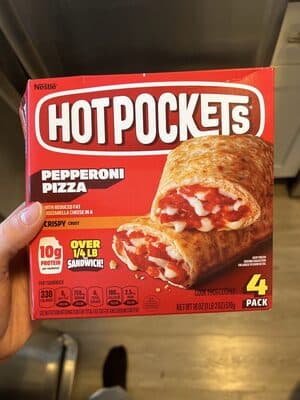
Pepperoni Pizza
Hot Pockets
Barcode 0043695206203
AVOIDIs Pepperoni Pizza safe?
Pepperoni Pizza by Hot Pockets is rated AVOID by BannedPantry: its label lists 4 ingredients that are banned or restricted outside the US — BHA (California, EU); BHT (EU, UK); Sodium Nitrite (EU, UK); Sodium Benzoate (EU, UK). All of them are still legal to sell in the US.
Flagged ingredients (4)
BHAmedium
Banned or restricted in: California, EU
Listed under California Proposition 65 as a carcinogen (since 1990), requiring a warning; EU permits it only as an antioxidant (E320) at limited maximum levels. IARC Group 2B.
BHTmedium
Banned or restricted in: EU, UK
EU/UK authorise BHT (E321) only in specified foods at limited maximum levels under Regulation (EC) No 1333/2008 and not in foods for infants/young children; the US permits broader GRAS use.
Sodium Nitritemedium
Banned or restricted in: EU, UK
Commission Regulation (EU) 2023/2108 lowered the maximum permitted levels of sodium nitrite (E250) in cured/meat products to reduce nitrosamine formation; US limits are higher.
Cleaner swaps for Pepperoni Pizza
Same category, none of the flagged ingredients.
Thrive Market Organic Pantry Starter Box
Thrive Market
Curated clean pantry essentials, all organic or non-GMO.
Simple Mills Almond Flour Crackers Variety
Simple Mills
Clean ingredients, no artificial colors or preservatives.
Bob's Red Mill Organic Rolled Oats
Bob's Red Mill
USDA Organic, whole grain, no preservatives. Pantry staple swap.
As an Amazon Associate, BannedPantry earns from qualifying purchases. This never influences our ratings — .
Full ingredient list
enriched flour (wheat flour, malted barley flour, niacin, iron, thiamine mononitrate, riboflavin, folic acid), water, pepperoni (pork, beef, salt, 2% or less of spices, dextrose, lactic acid starter culture, oleoresin of paprika, sodium ascorbate, flavoring, sodium nitrite, BHA, BHT, citric acid), reduced fat mozzarella cheese (pasteurized part skim milk, nonfat milk, modified food starch, cultures, salt, vitamin A palmitate, enzymes), vegetable oil (soybean oil and/or palm oil), water, soybean oil and/or palm oil, margarine (palm oil, water, soybean oil, salt, mono , diglycerides, sodium benzoate and citric acid, soy lecithin, potassium sorbate and citric acid as preservatives, annatto and turmeric color, vitamin A palmitate added), salt, modified food starch, 2% or less of sugar, modified food starch, dough conditioner blend (calcium sulfate, salt, L-cysteine hydrochloride, garlic powder, enzymes), yeast, citrus fiber, dried garlic, dried onion, maltodextrin, citric acid, whey, potassium salt, soy lecithin, spice, paprika, natural flavor, dried egg whites, oleoresin color, dried egg whites
Common questions
Is Pepperoni Pizza banned in the United States?
No — every ingredient in Pepperoni Pizza is currently legal to sell in the US. However, BHA, BHT, Sodium Nitrite, Sodium Benzoate are banned or restricted in other regions: BHA (California, EU); BHT (EU, UK); Sodium Nitrite (EU, UK); Sodium Benzoate (EU, UK).
Which ingredients in Pepperoni Pizza are flagged?
BHA: Listed under California Proposition 65 as a carcinogen (since 1990), requiring a warning; EU permits it only as an antioxidant (E320) at limited maximum levels. IARC Group 2B. BHT: EU/UK authorise BHT (E321) only in specified foods at limited maximum levels under Regulation (EC) No 1333/2008 and not in foods for infants/young children; the US permits broader GRAS use. Sodium Nitrite: Commission Regulation (EU) 2023/2108 lowered the maximum permitted levels of sodium nitrite (E250) in cured/meat products to reduce nitrosamine formation; US limits are higher. Sodium Benzoate: EU Regulation (EC) No 1333/2008 permits sodium benzoate (E211) only in specified food categories at maximum levels and not in foods for infants/young children; benzene can form when benzoates and ascorbic acid co-occur.
What does the AVOID rating mean?
BannedPantry checks each labeled ingredient against food and cosmetic safety standards from the EU, UK, Canada, Japan, and California, with a citation for every flag. AVOID means at least one labeled ingredient is banned or restricted by a major overseas regulator, or is high-severity under our methodology. Ratings are never influenced by brands.
What can I buy instead of Pepperoni Pizza?
Comparable products without the flagged ingredients include Thrive Market Organic Pantry Starter Box (Thrive Market), Simple Mills Almond Flour Crackers Variety (Simple Mills), Bob's Red Mill Organic Rolled Oats (Bob's Red Mill). You can also scan any product's barcode free at https://bannedpantry.com to check it before you buy.
Run a full ingredient scan
See exactly which ingredients in Pepperoni Pizza are banned overseas, with sources.
Scan now →BannedPantry — Our scores are never influenced by brands.